As of three weeks ago, I became the proprietor of an Etsy.com shop named Nostalgicats. I have no particular affection for the name but I was stumped to come up with something on short notice.
My first items up were a set of demitasse spoons and a set of Royal Albert china. I've added a couple of items most days and right now have 15 listings. At first, I didn't think I'd sell anything or that anyone would even see my shop. There are so many listings on Etsy, far more than I can comprehend and I am not willing to spend more money to get my pictures farther up the queue.
I did a lot of Ebay several years ago. Ebay has become more confusing with their charges and listing options. I like the simplicity and appearance of Etsy shops but there are some items that don't belong there and will have to back to Ebay. The best part of all this is that I am inspired to go through drawers and cupboards and haul things out, then make choices. I put things in piles: Keep, Sell, Donate, Trash. Undecided items go back into Keep pile for now.
The downside is that I am cluttering by having stacks of stuff that needs to be photoed and listed, then put away until sold. Packing materials and supplies need to be stored where they are accessible. This okay with me though. I find myself organizing my house around my activities so I use the space, instead of feeling guilty about dirt and clutter piling up in rooms that are intended for traditional purposes.
The danger of Etsy and Ebay though is seeing things that I have to have. I have fallen several times already and racked up a few disappointments so that I am far more careful. It's also fanned the fires of my desire to craft things, particularly involving fabric and embellishments. I already have a huge basket of knitted and crocheted items that no one particularly wants and no, they would never sell on Etsy.
One thing I have learned is research, research, research before listing. (Probably should do that before buying but that's all about the impulse.) I have found several things are actually worth more than I would have thought due to names on the labels. At first, I would look up items like silverplate flatware and find it was worth far less than I hoped, so I was starting to get lax. Then I looked up a label on some cloth napkins my husband bought at a garage sale and found out they were the product of well-known designers (not well-known to me, obviously.) That added a few bucks to the asking price - not enough to make me rich.
Volume is the answer though. I'm not going to sell one or two items and go on a cruise for a year. Lots of little stuff, mostly under $20, will add up. It adds up, or I'm hoping it will begin to add up.
Are there any other Etsy or Ebay fans? Do you sell on either one? If you buy, are you disappointed at times? Share your experiences, please!
Wednesday, April 24, 2013

Friday, April 5, 2013
Hoarding on TV: Reality or not?

I've also seen a couple other series that take a kinder, gentler approach. The one I liked best was "Clean House" which I believe is off the air. "Clean House" wasn't really about hoarding; it was about clutter getting out of hand. Since there is a narrow line between cluttering and hoarding, there were some run-ins with hoarders, but most of the people represented on Clean House were folks like you and me (me anyway) who had simply become overwhelmed by their stuff and too depressed to do anything about it. This would result in a toxic household in which no one would take responsibility for starting the process of cleaning up.
Now let me come clean (oh, so clever) on my household status. We've got a whole lot of clutter and hoarding going but have not graduated to garbage house. In fact, we regularly remove clutter and reorganize the stashes to keep things livable. But we've lived in the same house since 1987 so the problems run deep. I tend to be messy, the sort of person who winds up with stacks of papers everywhere. My husband thinks of himself as a collector, which is what a lot of hoarders call themselves. He is also a natural, ingrained recycler, meaning that he saves many things that could be of use someday. No doubt a handy trait in the pioneer days.
I gave up my background to explain my interest in Hoarding as an issue. My "domestic matters" are deeply affected and so the subject will come up on this blog a lot. But not every post, I promise.
Back to the Hoarding shows on television -- the situations and people appear to be real. I can only manage to watch an episode or two every few months. I watch because I think I might learn something about the process of change, but I never do. Somehow, if it happens at all, it seems to happen off-screen.
Both shows follow a similar formula. A hoarder reaches a critical point in her or his life where they must change or lose everything. Eviction, condemnation, health issues and so on are the usual reasons. In some cases, the hoarder's house has deteriorated beyond restoration and has to be pulled down. One episode, the landlord was trying to evict a man who could only get into his house by going to a neighbor's apartment and crawling out onto the fire escape to climb the stairs and enter his own kitchen window.
Obviously, these are the most extreme cases which make the best television. As the episode unwinds, the family and friends of the hoarder (sometimes victims) come upon the scene and try to offer help and support. Often the support from close family members (siblings, children, parents, spouse) deteriorates into rage and recriminations. A therapist becomes involved to oversee the situation and to be honest, appear to be wretchedly ineffective, no matter how experienced.
The camera lingers lovingly on the worst of the clutter. Given how extreme these cases are, most rooms are piled with junk so high that no one can walk in them, much less know what lies beneath the piles. Garbage hoarding is the worst, with long shots of vermin skittering around and slime growing up the walls. Generally the hoarders themselves have reached a point of wanting to change or understanding they need to change but simply cannot. Once in awhile, a stubborn hoarder will be featured who will declare themselves problem-free and claim to like living as they do.
After establishing the dysfunctional household and family group, the next phase of the show is the clean-up. This is the part where I pay attention and feel I have learned the most as far as what not to do or say to a hoarder. Usually a volunteer group is brought into clear since the volume of garbage and clutter is staggering, beyond the capability of being cleared by just a couple people. They are led by a professional organizer, who always claims to have experience with hoarders.
The cleaning day might start well, with the hoarder enthused and energized,until they discover that someone threw away something of value. Might I mention here that this is inevitable, since hoarders value things for unfathomable-to-the-rest-of us reasons. Pandemonium ensues as the hoarder wants to inspect every plastic bag that has left the house. OH NOES! Treasures are being stolen! Everyone must back off now and sit while the hoarder tries to start hauling items back into the house.
The therapist dithers around the hoarder, offering up socio-speak that the hoarder usually ignores. Close family members lose it, shouting in rage, initiating confrontation, trying to browbeat the hoarder into recognizing how their behavior has stifled the entire family, that there are other victims involved here. None of this works. The organizers pops in repeatedly to berate the hoarder about time running out, the volunteers need to go home, the truck needs to leave etc.
Will the hoarder succeed or not is the big question as the show cuts to a commercial break. How will this painful mess get sorted out? When the show returns, the hoarder will have given up or...the house will be cleaner to some degree, at least livable again. Sometimes the family is enjoying a meal in their kitchen that is now functional again. But oftentimes, as in reality, the hoarder returns to their home after the meltdown and remains mired in their trash.
I would like to see what takes place during that commercial break (kidding, I know that what goes on takes a lot longer). How did the hoarder come to the point of letting everything go? This is the most important thing that I and many other viewers need to know. I know they didn't clear the house in a single day or even a weekend, so how long did it take? Did the therapist convince the family to get into group counseling instead of just treating the hoarder? I have these questions and many others.
Maybe I expect to much from a "reality" TV show. Just typing that sentence and looking at it makes me feel naive. These shows are sensationalizing and exploiting families that need help. But at least hoarding awareness has increased extensively, resulting in a lot more study and resources for information. That's a good thing, as Martha would say, and is helpful to me and my family as we struggle to bring order to our home.

Friday, March 29, 2013
Where To Begin Again?
Hi, my name is Maggie and I'm a blog-a-holic. Not a compulsive reader of blogs, but a compulsive creator of many abandoned sites. For the past year, I've had a good excuse for this: I was diagnosed with breast cancer last April (2012) and have been hoeing a long row ever since. I am not restarting a blog for that reason though, although the subject is certain to come up.
My brain function, due to various upsets, has been recovering in fits and starts so that consistency in writing ability has been slow, to put it mildly (and with a cliche.) But there are many topics that I have been interested in writing about yet hesitated, not wanting to deposit yet another tiny droplet of my thoughts into the vast oceans of cyber-space. Since my current life is currently about domestic pursuits, it is here that I have chosen to start again. This time around though, the domestic matters will delve beyond recipes and knitting -- although those are still important too!
I'm keeping this entry short and sweet so I can to work on my next planned entry - the topic of hoarding and its impact on my familys' life. No promises on when I'll finish that one.
My brain function, due to various upsets, has been recovering in fits and starts so that consistency in writing ability has been slow, to put it mildly (and with a cliche.) But there are many topics that I have been interested in writing about yet hesitated, not wanting to deposit yet another tiny droplet of my thoughts into the vast oceans of cyber-space. Since my current life is currently about domestic pursuits, it is here that I have chosen to start again. This time around though, the domestic matters will delve beyond recipes and knitting -- although those are still important too!
I'm keeping this entry short and sweet so I can to work on my next planned entry - the topic of hoarding and its impact on my familys' life. No promises on when I'll finish that one.
Monday, May 7, 2012
Easy Overnight Oatmeal
I'm working on making my daily diet more fiber-rich and plant-based. It's been easy for me to eat way less meat than I used to, but getting the "right" foods in has always been problematic. Eating steel-cut or old-fashioned oatmeal with fresh fruit is a delicious breakfast, but not as easy as popping waffles into the toaster!
I started googling various shortcuts to preparing the steel cut oats, which my father prepares quite deliciously by simply cooking them on the stove. His method isn't particularly hard but still more work than I'm willing to put in on a daily basis. Here is how he does it:
Boil quantity of water per directions on oat package.
Chop up an apple or two, depending on how many servings. (He peels them too, but I don't think you would need to)
After apples are soft and cooked, add the oatmeal.
Stir and cook for about ten minutes, until oats are soft.
Now here is the magic ingredient he adds that elevates it:
Spray a nice dollop of whipped cream into the mix.
The result is outstandingly delicious, especially since he serves it with more cream and brown sugar to add. So not quite as healthy as could be.
A few months ago, I found many recipes that called for assembling the oatmeal in a slow cooker or crockpot and then cooking overnight at low heat. This sounded appealing and there were some fruit additions, like cut up apples or blue berries. However, I found that I was never interested in putting it together in the crockpot when it was late at night, especially since I'd have to make a large quantity. Although honestly, it is supposed to be reheatable even if no one else was interested in it.
Finally, I came across some easier methods. Placing the oats, liquid, and other flavorings in a glass jar overnight. In the morning, swirl and eat it cold. Sounded perfect for this time of year, as hot oatmeal isn't so appealing as summer moves in.
So I conducted a few experiments using this method shared on the blog The Yummy Life, which has six different suggestions for ingredients, but follows the same basic method each time. Here are my results so far:
Peanut Butter Banana: I made this and almost liked it a lot. What was wrong was that I used Smart Balance Peanut Butter which doesn't really have the best flavor. It would have been better with Skippy. Also, the peanut butter clumped a lot, although vigorous stirring helps, but didn't eliminate the blobs. As for the banana, I would recommend holding that out for the overnight process and adding it in freshly cut before eating. (There is an oddness is the flavor of bananas that bothers me anytime I eat them raw but not immediately.)
This recipe called for 1 tsp of honey, but I added at least two. That wasn't sweet enough so I have to say it takes about a TBSP of honey to make it sweet enough for me. Possibly that would be resolved by using a sweeter peanut butter and adding bananas as I suggest.
The second experiment was with berries. I had fresh strawberries and blackberries and I liked the results a bit better, although again, some of the fruit just tasted off. I think I'd add this type of fresh fruit just before eating.
My last effort was my own ingredients with the same method. I used canned light coconut milk which was leftover from another meal. I also added some fat free half and half and a tbsp of rock sugar. It came out with good flavor (assuming you like coconut flavor) but the texture didn't work at all. I stuck it in a microwave bowl and microwaved for about a minute and that was much better.
My conclusions on this experiment are this. It is easy to assemble the oatmeal, liquid, and some sweetners in a jar to eat the next morning. You don't have to do it late at night as with the crockpot method, because the mixture is good for several days. If you eat it the next morning, it is rather chewy, which I don't mind. However, microwaving it a minute or so will soften it up nicely and be a warm bowl of oatmeal, which some might prefer. I will stick to adding fresh fruit before I eat, rather than overnight for the time being, but might try again with applesauce or canned fruit in the winter.
I started googling various shortcuts to preparing the steel cut oats, which my father prepares quite deliciously by simply cooking them on the stove. His method isn't particularly hard but still more work than I'm willing to put in on a daily basis. Here is how he does it:
Boil quantity of water per directions on oat package.
Chop up an apple or two, depending on how many servings. (He peels them too, but I don't think you would need to)
After apples are soft and cooked, add the oatmeal.
Stir and cook for about ten minutes, until oats are soft.
Now here is the magic ingredient he adds that elevates it:
Spray a nice dollop of whipped cream into the mix.
The result is outstandingly delicious, especially since he serves it with more cream and brown sugar to add. So not quite as healthy as could be.
A few months ago, I found many recipes that called for assembling the oatmeal in a slow cooker or crockpot and then cooking overnight at low heat. This sounded appealing and there were some fruit additions, like cut up apples or blue berries. However, I found that I was never interested in putting it together in the crockpot when it was late at night, especially since I'd have to make a large quantity. Although honestly, it is supposed to be reheatable even if no one else was interested in it.
Finally, I came across some easier methods. Placing the oats, liquid, and other flavorings in a glass jar overnight. In the morning, swirl and eat it cold. Sounded perfect for this time of year, as hot oatmeal isn't so appealing as summer moves in.
So I conducted a few experiments using this method shared on the blog The Yummy Life, which has six different suggestions for ingredients, but follows the same basic method each time. Here are my results so far:
Peanut Butter Banana: I made this and almost liked it a lot. What was wrong was that I used Smart Balance Peanut Butter which doesn't really have the best flavor. It would have been better with Skippy. Also, the peanut butter clumped a lot, although vigorous stirring helps, but didn't eliminate the blobs. As for the banana, I would recommend holding that out for the overnight process and adding it in freshly cut before eating. (There is an oddness is the flavor of bananas that bothers me anytime I eat them raw but not immediately.)
This recipe called for 1 tsp of honey, but I added at least two. That wasn't sweet enough so I have to say it takes about a TBSP of honey to make it sweet enough for me. Possibly that would be resolved by using a sweeter peanut butter and adding bananas as I suggest.
The second experiment was with berries. I had fresh strawberries and blackberries and I liked the results a bit better, although again, some of the fruit just tasted off. I think I'd add this type of fresh fruit just before eating.
My last effort was my own ingredients with the same method. I used canned light coconut milk which was leftover from another meal. I also added some fat free half and half and a tbsp of rock sugar. It came out with good flavor (assuming you like coconut flavor) but the texture didn't work at all. I stuck it in a microwave bowl and microwaved for about a minute and that was much better.
My conclusions on this experiment are this. It is easy to assemble the oatmeal, liquid, and some sweetners in a jar to eat the next morning. You don't have to do it late at night as with the crockpot method, because the mixture is good for several days. If you eat it the next morning, it is rather chewy, which I don't mind. However, microwaving it a minute or so will soften it up nicely and be a warm bowl of oatmeal, which some might prefer. I will stick to adding fresh fruit before I eat, rather than overnight for the time being, but might try again with applesauce or canned fruit in the winter.
Friday, December 23, 2011
Klejner (known as Fattigman among those of Norwegian extraction)

I am somewhat conflicted regarding my Scandinavian heritage. My mother was adopted into a Danish familyand was reared with proud Danish tradi
tions. After she died, I discovered her biological roots were Norwegian. This fact, combined with my brother-in-law having Norwegian roots and being an excellent cook/baker, has brought me to thinking Norwegian over Danish in my later years. But still, all my early Christmas traditions center around Danish memories. And the one tradition that I insist is better in Danish form than Norwegian is that of the Danish donuts known as Klejner (pronounced klein-er) over Fattigman (futty-mun?)
This is the sort of recipe that demands participation. In other words, don't try this alone. Better yet, have someone present that has done it before or at least witnessed the process. Be prepared to have a lot of cookies when you're done even though the dough might look small. I have erred by doubling the batch and believe me, it was a long night frying dough.
One last attempt to dissuade anyone from making these: the clean-up is horrendous. The more frying pans you have, the faster it will go but the more to clean. Without further ado, here is one last recipe handed down by my mother from her (Danish) mother:
Klejner (Danish Donuts but really fried cookies)
3 eggs
1 cup sugar
1/2 tsp salt
4 tbsp cream
1/2 cup MELTED butter
1 tsp baking powder
3-4 cups flour
1 tsp vanilla or cardamon (I've only ever had them with cardamon)
Beat eggs and sugar together, add cream, melted butter, and then dry ingredients.
Add enough flour to make a still dough. Chill for easier handling. (Impossible to handle if not chilled.)

Take about an orange-sized gob of dough (err on the less rather than more) and place on a floured surface. Roll flat. With a pastry wheel (or pizza cutter), cut diagonal lines resulting in diamond shapes (or pointed rectangles as my original recipe says.) Make a small slit down the center of each shape.
The picture to the right is pretty accurate except for the extra margin of dough cut out between the individual cookies. I've never done that.

Shape the klejner -- easier to show than describe. My mother's recipe simply says "turn through the middle." It really is easy, but work gently. Pull the center open slightly, then bend the top point back
and pull it through the middle toward you. I hope the picture helps explain this.
My recipe also lacks detailed frying instructions other than to say it takes about a pound and a half of shortening, although a larger fry pan might need 2 pounds. The melted shortening should be deep though and test by dropping a very small amount of dough. If it sizzles and starts browning, that should be right for cooking the batch.
Fry about six at a time, too many will cool the oil and ruin the batch. When light golden on the oil side, flip over and brown the other side. Meanwhile, your cooking companion(s) can be busy rolling out another batch. Drain on toweling after removing from the oil.
Continue working batches until most of the dough is gone. We always save scraps and reroll for more, but you can also cut into other shapes.
Luckily for today's cooks, there is the Internet. You can find You-Tube videos demonstrating the entire process which I recommend for complete novices. After looking at several online recipes, I see slight differences in amounts and ingredients. My family recipe results in a donut-like texture although crunchy rather than soft. The results are more raised than some of the flatter ones I've encountered.
Should I ever have enough ambition to tackle these again, I might try a bit of lemon zest to punch up the flavor. They can tend toward the bland side so using fresh grated cardamon instead of powdered might give them more zip too.
Store them in tins lined with wax paper or paper towels. They actually last a long time but you could try freezing (probably come out soggy when thawed).
This is my last entry about my Christmas cooking traditions. Thank you for reading and may you enjoy the holiday season whatever way you celebrate.
Thursday, December 22, 2011
Aebleskiver - Danish Pancake Balls
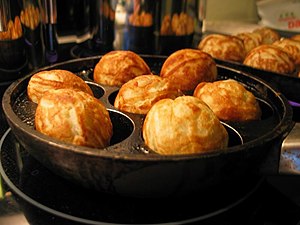
The food that evokes the most childhood memories of Christmas and New Years would have to be Aebleskiver, which are literally pancake balls made in a special pan. My Grandmother made them every Christmas, usually as a late night treat after we'd all consumed a full dinner and dessert. Later, my mother would make them at random times throughout the year, but especially at Christmas.
My Grandmother was of German descendant but was raised in Denmark. She worked as a professional cook in private homes before coming to American to marry my Grandfather. (I have a wooden spoon of hers that my mother held onto, it is worn down to a nub on the end. I still use it.) She taught my mother and both were excellent cooks, although baking skills eluded her. My happy memories of her cooking are the aebleskiver and her crepes, which we always called Danish pancakes. My worst memories are of her cookies which were just strange at best, but generally hard and dry.
My recipe is the traditional one handed down by my Grandmother through my mother. It has yeast which makes it a bit of a pain, since that means a two hour rise time (possibly less with fast-acting yeast). There are decent buttermilk recipes out there and I daresay if you've never had the yeast version, they are plenty good. And I have to admit that my Norwegian-American brother-in-law did serve a buttermilk version a few years ago that was every bit as good. But this is Christmas week so here is the real deal.
Aebleskiver
4 Eggs
2 Cups flour
2 Cups rich milk (I take that to mean whole milk which is what I use)
1 Tbsp Sugar
1 Yeast Cake (I use one packet)
1/2 tsp salt
1/4 tsp cardamon
Dissolve yeast in sugar and salt. (Yes, it dissolves in dry ingredients)
Heat milk to lukewarm (should not burn your wrist but be very warm, as if you were warming formula for a baby)
Blend milk and flour, then add the yeast/sugar mix.
Beat in eggs one at a time (my mom would say if you use an electric mixer, you can add eggs all at once, these instructions are for hand mixing.)
Cover bowl and let rise for two hours (batter will rise to double)
Bake in aebleskiver pan:
An aebleskiver pan is round and has a ring of indentations around it. There is no substitute so do not make this recipe unless you have one or can borrow one. A good pan can be cast aluminum; the old style are cast iron (and apparently becoming valuable).
Spray the pan with non-stick spray before heating. This is obviously a modern touch but the other option is to rub it with oil. In fact, if you have a new cast iron pan, you'd probably better season it first.
Set the pan over medium high heat. In a separate small pan, melt down a good size chunk of shortening. Do not use vegetable oil here and do not use butter. If you really object to shortening, maybe veg oil would be okay but butter burns too fast.
With either a small ladle or a tablespoon, pour a tad of melted shortening into each indentation in the pan. The idea here is that you are deep frying individual balls. Follow with enough batter to almost fill each hole.
When the aebleskiver batter begins to bubble, check to see if one of them is nicely browning. Just use a fork to lift gently and look. If it is not liftable, it has a way to go. You might have to adjust your heat if they seem to brown too fast on the outside but staying raw on the inside. Usually the first batch is the test batch as you adjust heat and oil amounts.
When nicely brown and the batter is looking cooked (think of a pancake being ready to flip, the batter is at least skinned over) flip the balls over in the indentations. A long handled fork is best for this, but I have heard that traditionists use knitting needles. Frankly, that has never worked out for me or my mother -- we seem to be fork people. Any tool that works is good enough.
It only takes about half a minute once they are flipped. Remove them from the pan carefully and place on towels to drain.
This is important: You must pour in fresh melted shortening for each batch you cook. So spoon out another round of oil and then add batter again. While this batch cooks, you can sprinkle powdered sugar on the cooked batch, or you can just wait until they are all finished.
We always put them in baskets (like bread rolls) and passed them around, already sprinkled with powdered sugar. My mother insisted they be eaten with currant jelly or jam which is fine by me, but my kids hate. We've found that lingonberries are quite delicious as a substitute, but any jam or jelly is quite good. My husband loves to put butter on them but they certainly don't need it.
Something I have never done but would like to try is putting the jelly in them while they are cooking, right before turning them. I've also heard putting a small chunk of chocolate in them while cooking is fabulous and I believe it would be.
Tuesday, December 20, 2011
Italian Wine Cake

This is not a traditional recipe from my family. I have no idea if it really "Italian" since Italy is a very divided place and overall, not really a cakey country, if you get my drift. Although there is a traditional Sicilian cassatta that I would love to adapt. But I digress.
I found this in a magazine (Better Homes and Gardens?) in the seventies. The ingredients were so unusual that I just had to try it, figuring it would be fabulous or horrible. It was fabulous. The picture above is a wedge, while my recipe called for loaf pans. You could easily adapt to any pan, including a Bundt, just do not overbake.
Italian Wine Cake
(Hint: you need a BIG bowl for this, although I can manage it in my Kitchen Aid bowl, but barely)
2 Cups Raisins
Place in a pan and cover with water. Bring to a boil and turn off heat. Set aside.
Cream together:
1 cup shortening
1 cup butter
2 cups sugar
Add to mixture one at a time:
3 eggs
Sift together:
4 cups flour (sift before measuring0
4 tsp cocoa
4 tsp baking soda
2 tsp cinnamon
1 tsp nutmeg
1 tsp allspice
Add sifted ingredients to the batter alternating with 2 1/2 cups of Burgundy (or red wine of your choice -- Charles Shaw would be a decent option)
Fold in the raisins last. Divide the batter among 3 9x5 greased loaf pans.
Bake at 350 for 50 minutes (worth repeating, do not overbake, it dries out)
Let cool for at least 10 minutes before turning out onto a rack.
I've never frosted it but I'm sure a glaze of some sort would be quite good.
Subscribe to:
Posts (Atom)